WKND Lab – Artist Interview in Collaboration with SCHAUPLATZ MAGAZINE
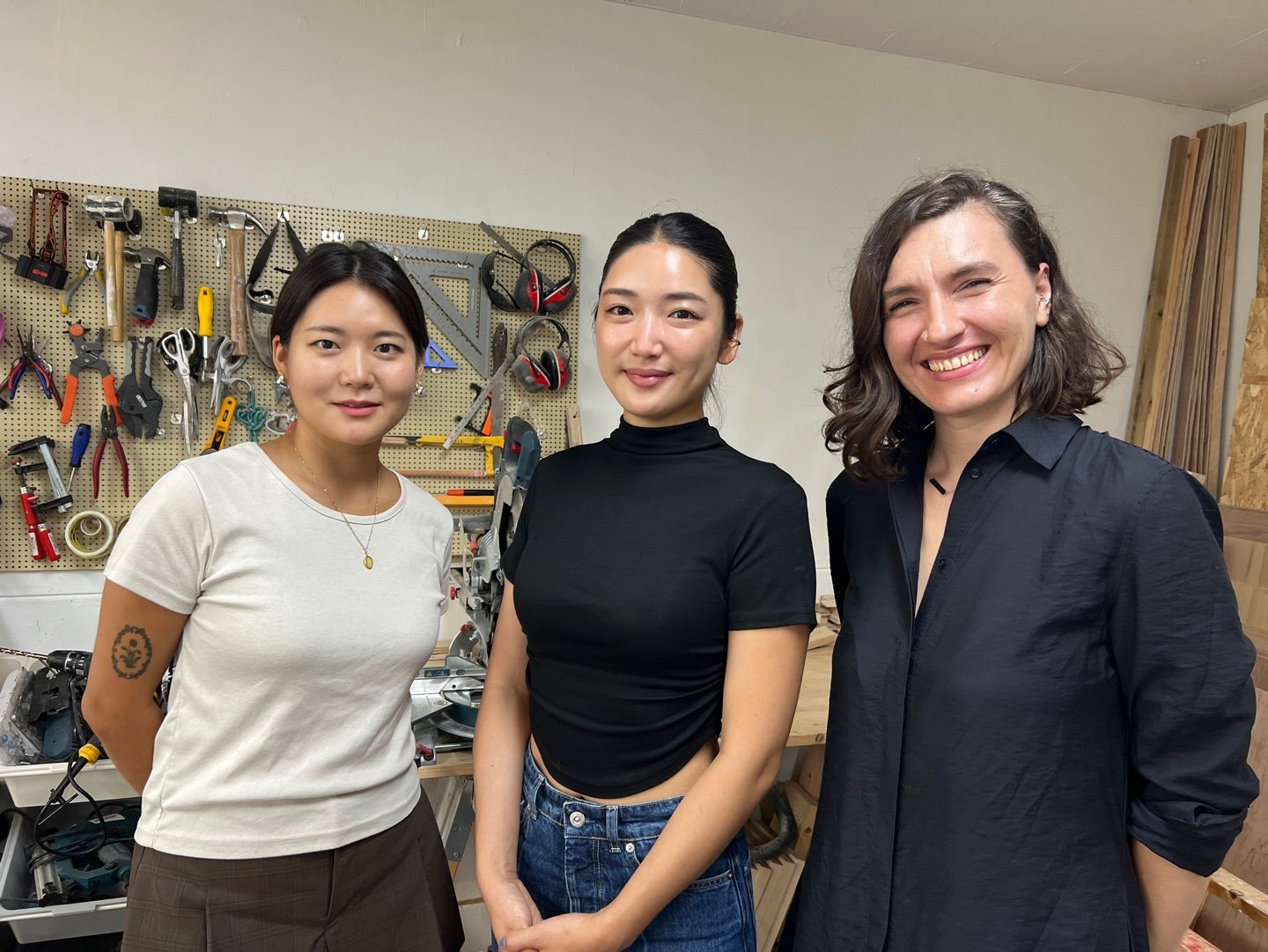
Credit: Courtesy of Schauplatz | Photographer Daniel Thomas Faller
To celebrate the release of the first edition of SCHAUPLATZ MAGAZINE, I'm thrilled to share my artist interview with WKND Lab – a design studio led by Eunji and Lin.
I've been an enormous fan ever since encountering their work in person at DEFINE Seoul 2024, a contemporary art and design fair held in Seoul that intentionally blurs the boundary between fine art and design. Feeling bold, I reached out to arrange a studio visit – and the amazing discussion that followed ultimately led to this article collaboration with SCHAUPLATZ MAGAZINE, introducing the duo to our readers.
Before we dive into the conversation, I wanted to take this opportunity to introduce SCHAUPLATZ, the partner for this project. As Claudia Toenz, one of the co-founders, beautifully put it: "When exploring the intersection of traditional heritage and modern design, it helps to wander with those who know how to look beneath the surface."
Founded by two Swiss expats based in Seoul – Claudia Toenz and Daniel Thomas Faller – SCHAUPLATZ operates as both a premier boutique travel designer and the publisher of SCHAUPLATZ MAGAZINE: a biannual publication dedicated to unvarnished, human-focused storytelling across Korea and the Swiss Alps. With their "low-tech, high-touch" philosophy and deep reverence for raw texture, material culture, and local craftsmanship, they don't just plan trips – they open doors to the authentic, unscripted soul of a place.
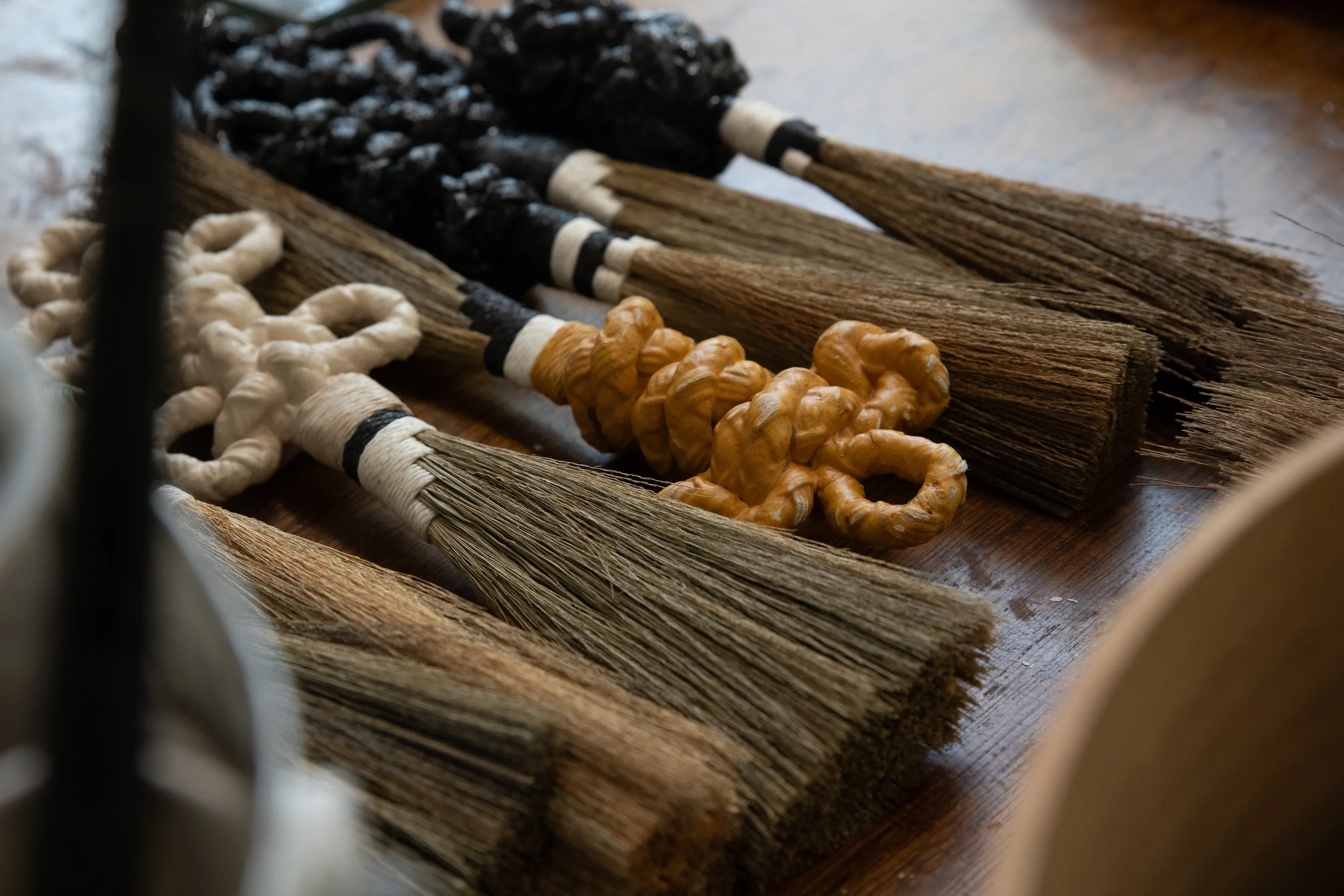
Credit: Courtesy of Schauplatz | Photographer Naomi Bromley
DKL: Thank you for meeting with us despite your busy schedule – I know you've been traveling quite a lot recently. As a big admirer of your work, and particularly because of your strong Swiss connection, I thought you'd be the perfect choice to introduce to the SCHAUPLATZ MAGAZIN audience. Perhaps we could start with the story about how you met and how WKND Lab came to be. What was the inspiration behind the name?
WKND Lab (Eunji): So we met at Korea National University of Arts [Kor: 한국예술종합학교, widely regarded as the most prestigious art school in South Korea, established in 1993 as the country's only national university dedicated to the arts]. We hit it off from day one and immediately became best friends. At some point, we both applied for a student exchange program – I got to go to Switzerland and Lin went to Germany. And since we were used to spending a lot of time together, we missed and called each other frequently. University kept us busy and we only really had time during the weekends. So that's why when we decided to work on a project together, naturally, it became our thing during the weekend – hence the name, WKND Lab. At first, we started off as a three-person studio, but the other friend decided to get a corporate job and left. So now it’s us two.
DKL: I love the origin of the name. Let’s discuss your connection to Switzerland a bit more – when we first met, you mentioned you majored in object design, is that correct?
WKND Lab (Eunji): Yes, at Lucerne University of Applied Sciences and Art.
DKL: As a Polish person who studied art in Korea, I see – especially after all these years, how deeply Korean aesthetic has shaped my own artistic language. Do you feel that Swiss or European design in general has influenced your artistic expression in a similar way? Or how do you see that influence or that being part of your artistic journey?
WKND Lab (Lin): For me, I've spent my whole life in Korea, and I've been used to the Korean academic system. So when I first went to Germany as an exchange student, one of my professors – I think it was typography class – told us to do whatever we wanted. In Korea, there's always a topic. Always do this, make a book, video, something about this topic. And in Germany we were told to do whatever we wanted. At first, I was confused and couldn’t think of anything. Then I started to wonder about what I wanted to do. I think that perspective changed me a lot. Simply asking myself: “What do you want to do?” I did crappy things that I wanted to do (laugh). Why not? You have to start with something, somewhere, right? For Eunji, too, I think she prospered at her university. Her project led to us become WKND Lab. I think those kind of experiments really changed us. Just being in other circumstances, having a different experience to what we knew from Korea.
WKND Lab (Eunji): I have similar feelings. I grew up in a very artistic household, my mom is a painter, my dad is a lot of things. He's a game graphic professor, but he painted and majored in ceramics. My mom is also dedicated to painting. Growing up, I was always telling myself, that I did not want to do art or design. Maybe partially, I thought I was not going to be as good as them. As a kid, I was really interested in science, I always saw myself as being super practical, the opposite of my parents. Very industrial kind of mindset. But my Korean professors actually always criticized my work for being as too fine art-like. Receiving that kind of feedback made me question whether industrial design was the right path for me, whether working mostly on computers, using software was the direction I wanted to take. Then I went to Switzerland, and I had a variety of possibilities. I had so much freedom and it changed my mindset. Being exposed to European designs impacted our design as well – contemporary, modern style, rooted in Western design e.g., Bauhaus. Design taught in Korea is also rooted in Western rather than Korean traditional design. But studying abroad and having a third-person perspective about the two worlds, helped us to embrace both of them. Does that make sense?
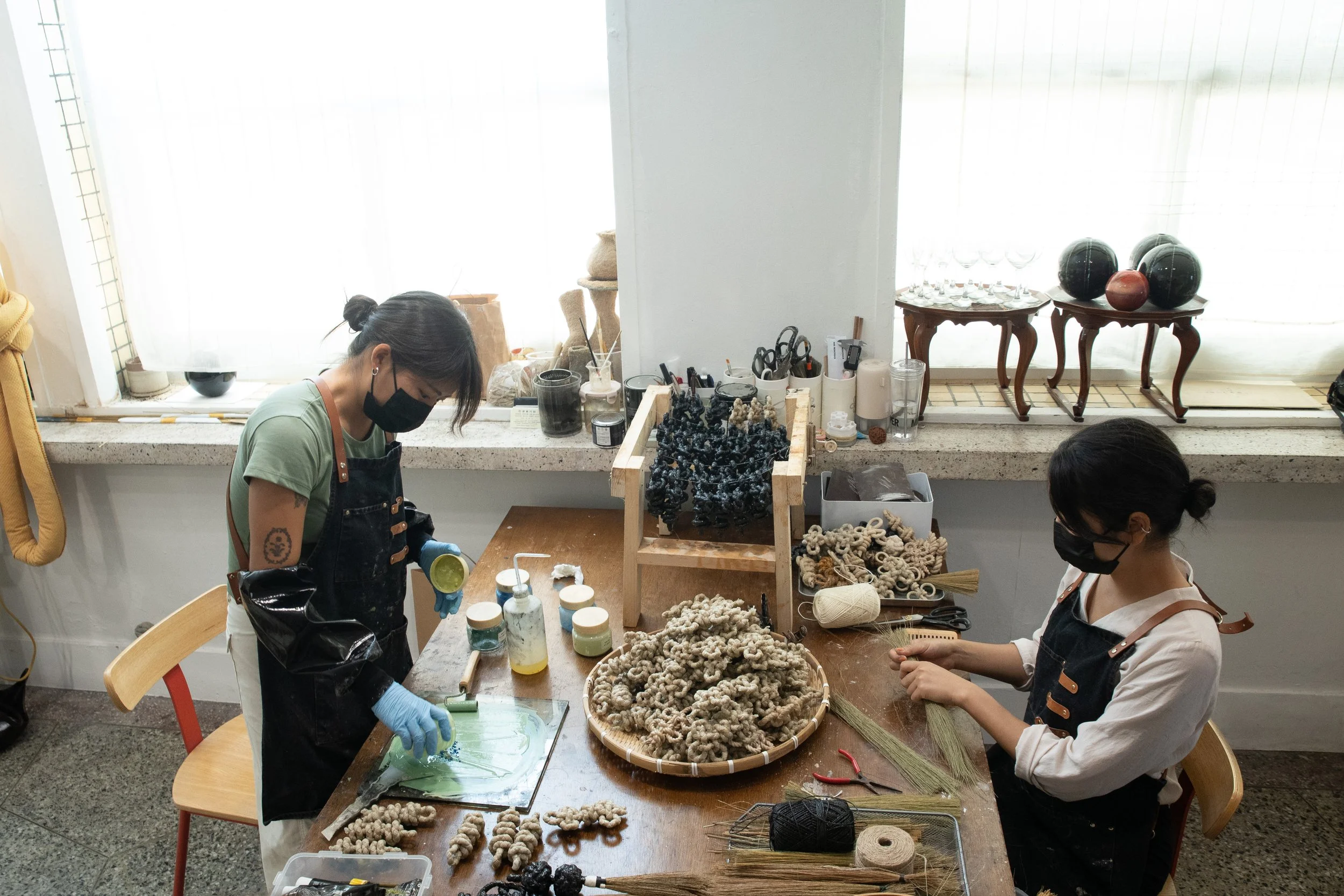
Credit: Courtesy of Schauplatz | Photographer Naomi Bromley
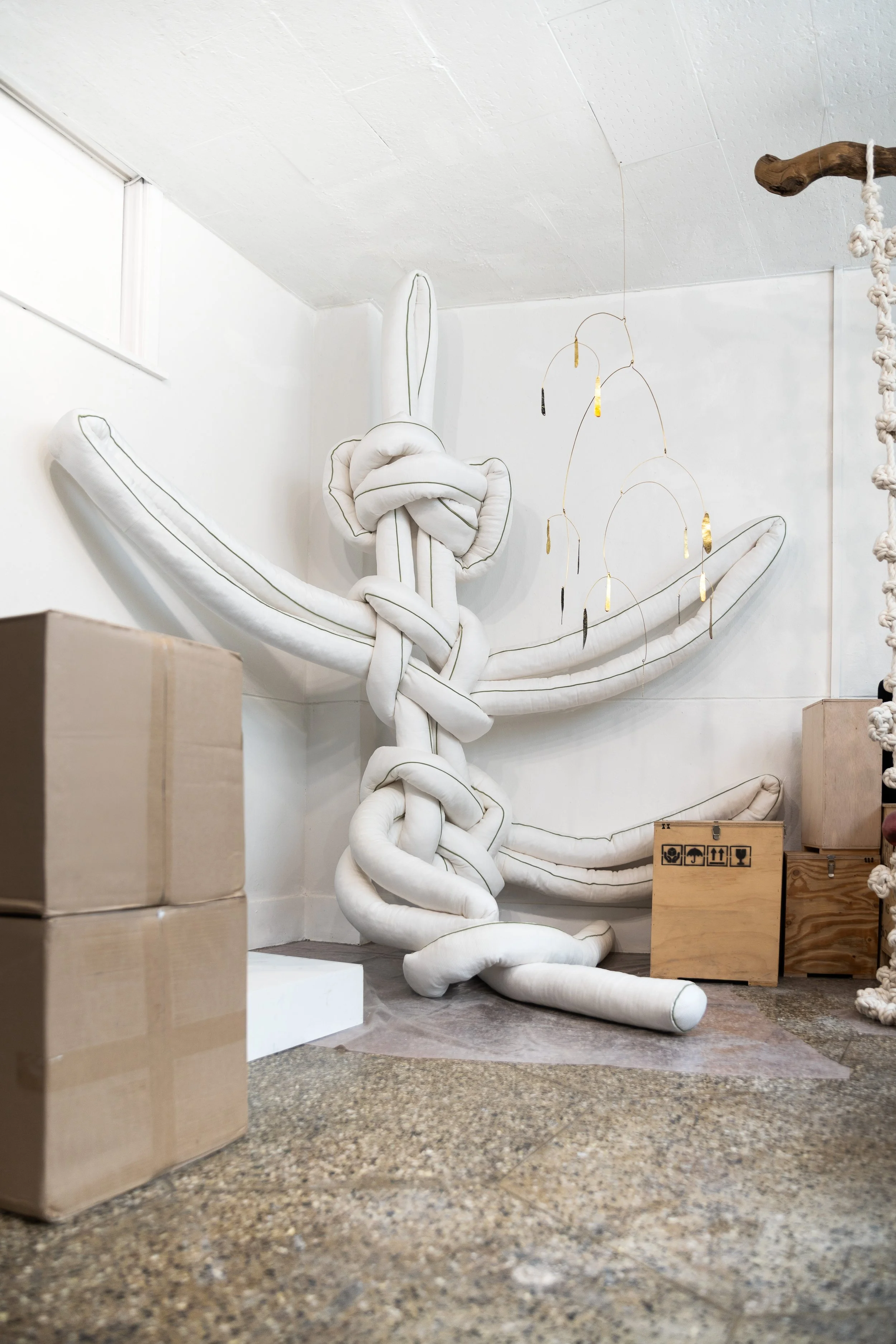
DKL: It makes perfect sense. I came to Korea to study Western art. Why would you do that? (laugh) It was quite ironic, but I think it helped me understand how Koreans see Western art, engage with that, and then at the same time, be able to take Eastern painting classes. One aspect of your work that I really deeply admire is your sense of scale. I think it takes courage to work in large formats, especially when reinterpreting traditional forms. Did that come naturally to you? How did the giant knot works come about, and how do you approach Korean traditional art in your design practice?
WKND Lab (Lin): At first, when we started our studio, we focused on materials. We would do oyster shells; we would try to reuse eggshells or milk. But as we went on, we started to take interest in Korean elements, and we figured that a lot of traditional materials are eco-friendly. At first, when we studied ottchil [옻칠, traditional lacquer], we were trying to replace glue, actually. As we learned more about ottchil we also got interested in hanji [한지, traditional Korean mulberry paper] – and we appreciated the eco-friendly, organic character. The more we learned, the more our interest grew – there are so many things to study.
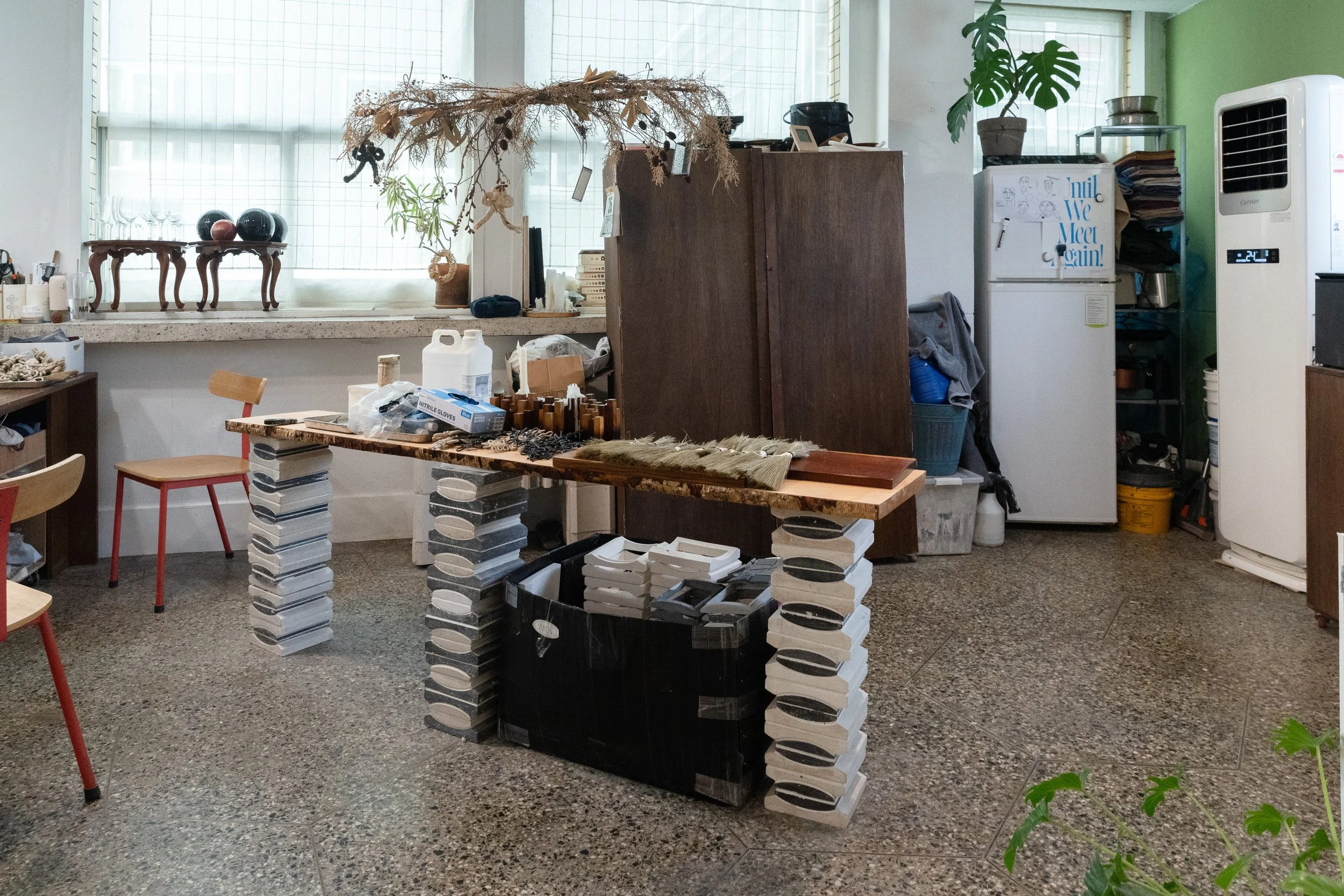
WKND Lab (Eunji): We have a small material library. I graduated as a material designer in Hochschule Luzern. Then I worked with milk casein –these are made out of milk protein. My thesis was about surplus milk and waste in Switzerland and how to reuse dairy product waste into an industrial material.
SCHAUPLATZ (Daniel): Swiss milk? In Korea? (laugh)
WKND Lab (Eunji): Yes, preserved (laugh). I contacted multiple Swiss manufacturers and one of them was able to help me.
SCHAUPLATZ (Daniel): So how can you use this material for daily use or for art?
WKND Lab (Eunji): It's not as stable as typical commercial materials, but suitable for an art piece as it turns into a long-chain polymer.
WKND Lab (Lin): So that was Eunji’s graduation thesis project and our first studio project. Then we moved on to eggshells, oyster shells as we had to switch to local Korean materials. Another project was using glass wool used in building insulation. It was a way to preserve the memory of torn down architecture in the form of a souvenir from the past. We got a prize from the Cheongju Craft Biennale for that project. We’ve experimented for two years but then we realized – we’re not product makers, we have to do art (laugh).
WKND Lab (Eunji): To go back to your original question – we started off as product makers and material designers; we focused on sustainability and eco-friendliness. But by practicing our studio and work, we realized that sustainability is not just only about the eco-friendliness. It's also about the individuals, also about the society, also about preserving the culture and heritage. That’s why we moved towards our current practice which takes Korean heritage and culture and reinterprets it in our way. So it can be merged and made more approachable to a wider audience.
Courtesy of Schauplatz | Photographer Naomi Bromley
DKL: What I love about your artwork is that it's not just something that you go see in a museum that's behind glass. But it's actually something that brings you joy right now in the moment. It's relevant to you now. You want to have it as part of your daily life, to surround yourself with it. Last time we spoke, you mentioned that because you did not major in traditional Korean crafts, you also have a bit more of a free approach to the topic.
WKND Lab (Eunji): Definitely. Ironically, we feel free to explore more. Because if I imagine myself majoring in a very specific directions, I think I would have felt compelled to follow the traditional methods. And while that is also important, our path gives us more freedom.
DKL: It’s important to understand and respect the origins of the craft. But at the same time, some of us take a different path. It’ not necessarily about replicating what was done but having the freedom and courage to make it individual. Adding your own flavor, without feeling constrained by tradition. You're Korean, so you have a strong understanding of the craft, but you also modernize it through your own approach.
WKND Lab (Eunji): We think that tradition is not just something that remains in the past. It has to be developed. In order to make tradition sustainable, you have to improve. We consider ourselves to be communicators not craftspeople. We would like to show more possibilities and discuss these topics through our work.
DKL: You have people who preserve the original technique, but you also need people who reinterpret it in a modern way – so it’s just different roles to play, one doesn’t diminish the other. On another note, I was telling Daniel on our way here that I admire your presence, you radiate warmth and openness. And I think that spirit is mirrored in your designs, because they're bold, but also inviting. And probably it's also what makes your work so accessible to international audiences.
WKND Lab (Eunji): I think since we exhibit mainly in Europe and sometimes in the US, we positioned ourselves in a space between Korea and the West which allows us to function as a bridge.
WKND Lab (Lin): Similarly, our new furniture (sofa) project bridges Korea and Japan – we have designed a gradient fabric, and it was produced in Kyoto. The inspiration for the gradient design was sumokhwa [수목화, traditional East Asian ink wash painting used to depict mountainous sceneries].
Courtesy of Schauplatz | Photographer Naomi Bromley
DKL: And what's next? What are you working on?
WKND Lab (Eunji): We just came back from Japan, and there we met with many artisans and visited different industrial factories, so we have some ideas for new projects. Even if Korea and Japan can be quite similar in terms of culture or mindset, we still find differences between the two countries – and we would like to embrace them. We are also thinking of scaling up some of our existing projects.
DKL: Thank you for being so generous with your time. We hope to see more of your work, perhaps also in Switzerland.
Credit: Courtesy of Schauplatz | Photographer Daniel Thomas Faller